How Automatic Synchronization Works
How It Works
When you select your video file, GpxOverlay reads its metadata without uploading the entire video. The app extracts the "date modified" timestamp and uses it as the video start time.
Keep your date set correctly
Make sure your camera has the correct date set. Check it on your PC if the video has a correct date (Date Modified) set.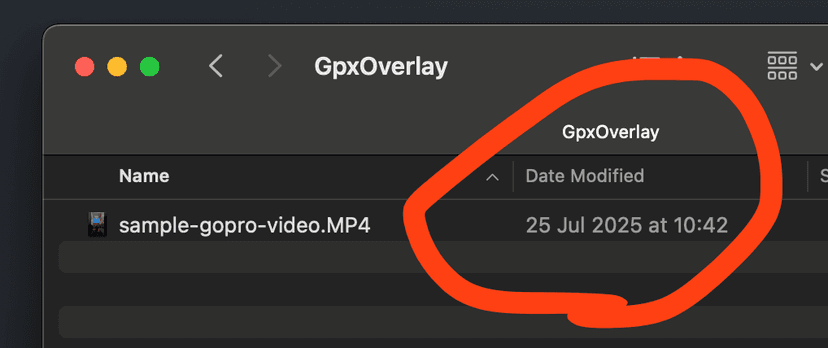
The Synchronization Process:
- Video Selection: When you select your video, only the metadata is read—the video file itself is not uploaded.
- Primary Match: GpxOverlay reads the "date modified" timestamp and treats it as the moment when the video recording started.
- Fallback Check: If that start does not overlap the activity, the app checks whether the timestamp is the moment the video stopped recording.
- Partial Match: When the video only partly overlaps the activity, the chart selects that overlap.

- Total miss: If neither interpretation overlaps, the video still loads. A short toast points you at the sync controls. The chart stays empty, and Next stays off, until the video window meets the activity.
Lining it up by hand
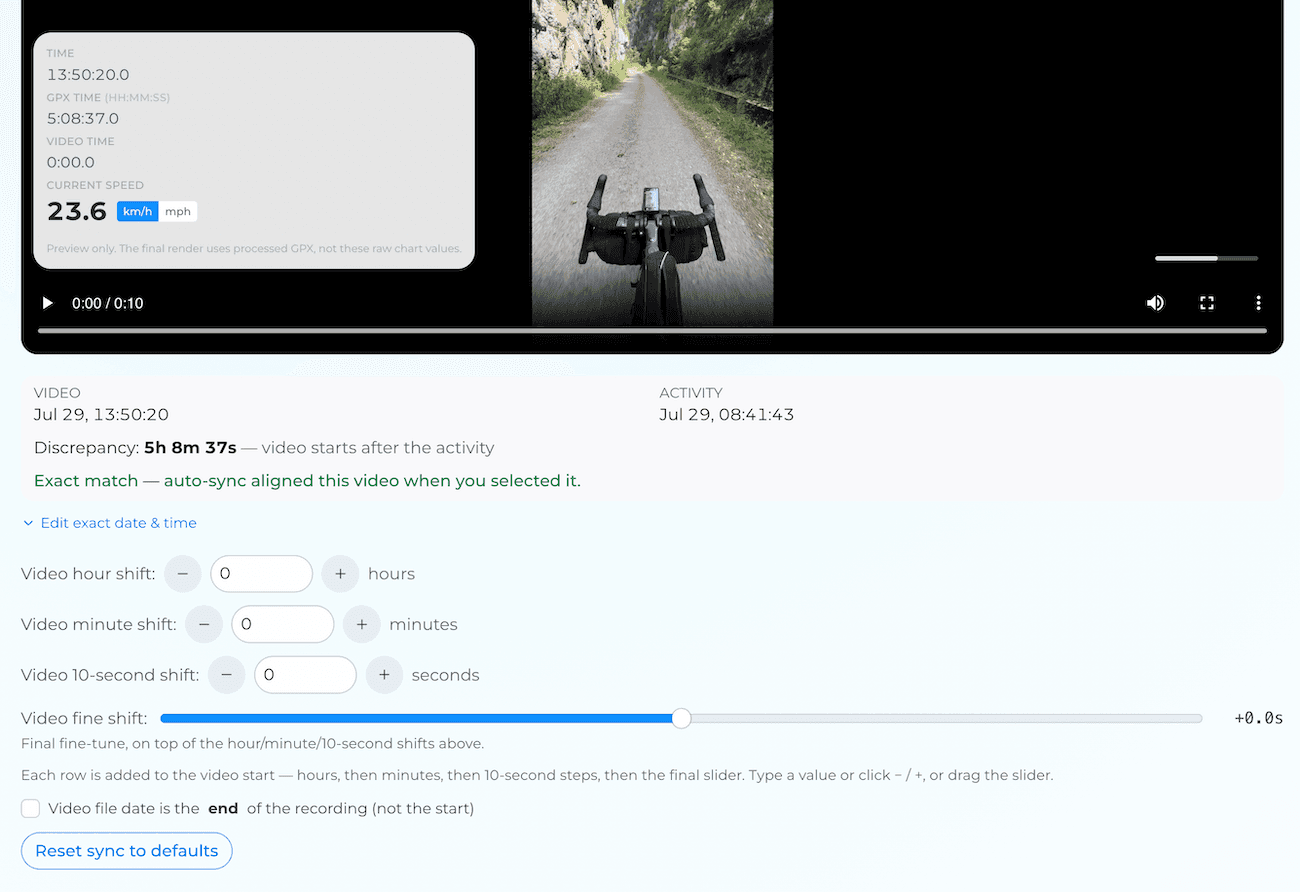
If there is an exact match, you will see: Exact match - auto-sync already selected a correct timeframe. Fine tune if needed.
If the match is only partial, or there is no match, use the controls to pick the timeframe. Over the video, a preview shows the offset and an approximate speed for that moment. The speed is a preview. The final render is smoother.
- Hour, minute, and 10-second shifts — type a value or click − / +.
- Fine shift — the last fraction of a second, in 0.5 s steps, on top of the shifts above.
- Edit exact date & time — for a large mismatch, such as a wrong time zone or a wrong camera clock.
- Reset sync to defaults — back to the timing from when you picked the file.
While a video is attached, dragging on the chart is off. Remove the video if you want to select a range by hand.
Full walkthrough: syncing your overlay with the video